
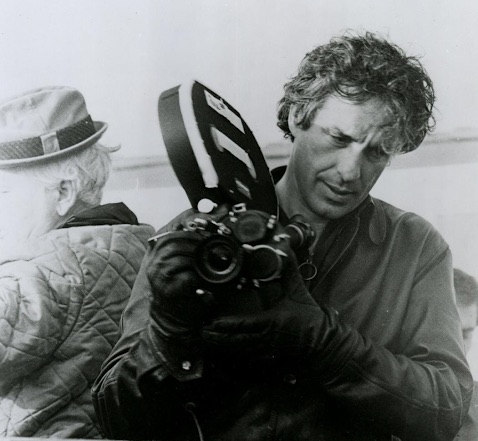
In the Spring of 1961, actor-director John Cassavetes, moved to Los Angeles from his home of New York City, to make his studio film debut. This was a major pivot for the young filmmaker; often accredited as the “Godfather” of American Independent Cinema, John had fought tooth and nail, to self-fund, self-cast, and self-distribute his debut feature film, Shadows (‘59), the first modern American Independent picture.
He casted his friends, took acting gigs around town to raise money, shot hand-held, had a tiny tiny crew, all features totally unlike the Hollywood system of filmmaking.
His was an ethos and drive informed by the New York Underground scene; fast-talking, streetwise, raw, and gritty, just like him. Instead of red carpet appearances, John lived at the jazz bars and dive bars, and yet still somehow woke up to read the funny papers at 6 o’clock in the morning.
He was a quintessential big apple resident, and yet as many Americans and American filmmakers do, he would be persuaded to venture and move to the promise of warmth and possibilities in sunny California (and by extension, Hollywood).

Born, John Nicholas Cassavetes, in Long Island, New York, 1929. John spent the first 33 years of his life, living, studying, breathing, and acting in the long shadow of the Empire State Building in New York City.
Following his graduation from the American Academy of Dramatic Arts, John would go on to open The Cassavetes-Lane Drama Workshop, as a sort of counter and alternative to the (then rising) Lee Strasberg school of method acting.
It is there that his particular brand of neo-realism and play-acting emerged; rejecting the “pseudo-psychoanalytical” and overly serious approach Stanislavsky and Strasberg pioneered, Cassavetes opted for a more freeform and real-time approach to performance.

This emphasis on improvisation and play resulted in the creation of his debut feature film, Shadows (‘59). The film centered around an interracial couple and the nightlife and jazz scene of late 50s New York City.
Unlike American releases at the time, the film was closer to a European arthouse film or more in line with the likes of Jonas Mekas and Shirley Clarke. It was raw. It was loose. The acting was not melodramatic but real. And the stakes were not overblown, but relatable.
The film was a landmark achievement, as Cassavetes wrote, directed, financed, and self-distributed the film himself. Most of the actors were cast from his acting workshops, and they even set-designed the workshop room itself to look like the lead family’s apartment.
There’s an infamous story about how the film got funded, with John’s plea at a radio show for listeners to send any amount of money they could so he could make a “real movie, with real people”. He purportedly raised over $2000 in small bills and checks sent through the mail.
Despite a disastrous first test screening, a ten-day reshoot would ultimately catapult the small project into critical success, eventually becoming beloved in England and arthouse theatres across America.
The buzz from Shadows eventually caught the eye of Hollywood higher-ups, as Paramount Pictures would go on to offer John a multi-film studio deal to work, write, and direct his own movies. He took the deal and permanently moved to LA in 1961.
The Killing of an American-Indie Filmmaker

Despite the promise of creative oversight, the Paramount Deal ended in disaster. The two films he’d make following Shadows completely divorced him from working within the Hollywood system (for practically the rest of his career).
His efforts to etch and sculpt his own niche of cinema were rebuffed.
To understand Cassavetes, one must understand his philosophy on both filmmaking and life. John, from the very beginning, often took the path of most resistance. He disagreed with shooting on sets. He resisted strict deadlines. Everything was in service to the performances.
He fought for his ideals every step of the way, fighting the studios over final cut, fighting for his actors and friends to get gigs and be hired, even fighting the acting style of the day.
Most filmmakers today still do not make films in the way of John Cassavetes. None did back in his time.

On Too Late Blues (‘61), his film immediately following Shadows, and his first studio assignment, he had requested to film on location in New York and cast his wife Gena Rowlands and actor Montgomery Clift as the leads of the film.
It was a story that sought to capture the underground milieu of late-night jazz scenes and the struggle between maintaining ethics as an artist, in the midst of potential financial gain. An all too familiar story to the starving actor turned director.
He had lived in these scenes, and there’s a kind of irony to how the film’s characters and leads dealt with the pressure of commercial influence amidst a sincere pursuit of the “art life”.
The studios promptly denied and rejected his request. He was forced to shoot the film in the studio backlot and was restricted from attempting his play-acting improv style during production.
The film would go on to be both a critical and commercial failure following its release.

The same story goes for A Child is Waiting (‘63), as again he sought to shoot in New York, but once again was sent to the lots, and even worse, lost final cut of the film.
His philosophical disagreements with producer Stanley Kramer, over the ethos and conceit of the project, led to his eventual ejection from the editing room and removal from the production.
The film centered around a home for intellectually and physically disabled children, and whilst John had sought to humanize and dignify their experiences, Kramer was a fervent defender of institutionalization.
His disagreements with John led to his re-editing of the film into a far more sentimental and saccharine drama, a point Cassavetes vehemently opposed.
John would ultimately disavow and disown the film, immediately upon its release. He had uprooted his life and moved his family across the entire country, just to lose both the films he was promised to by the studios, to studio oversight and tampering.
He would subsequently leave Paramount and reject a continuation deal of 5 more studio movies. Instead he went on hiatus; he would not release another film for the next 5 years.
The Only Living Boy In New York

Amidst his directorial efforts during this period, to remain financially afloat, Cassavetes maintained his acting career, turning into a quasi-journeyman actor. He’d patch up scripts for hire, and worked to make the best out of his situation.
Meanwhile, his turbulent studio stint invariably shifted something in him following 1963. Realizing he could never make the movies and films he actually wanted to in the studio system, Cassavetes would return to his old model of self-dependency and self-funding in his subsequent projects.
If he could not make his movies with moviemakers, he would make them himself, with his friends and family in tow. As he did with Shadows, he’d cast familiar faces (most importantly his wife) for the roles in his upcoming film, and decided to make his home the principal setting of the movie.
Through the efforts of him and Gena taking up gigs in movies and running around town asking for money, with only a crew of 7, he would spend a whopping 3 years working and filming what most consider the start of his “official canon”, Faces in 1968.
The run of “proper” Cassavetes had begun.

Faces (‘68) marks the beginning of Cassavetes golden period. For a decade and a half, he would release 8 of some of the best films ever made. From the likes of Husbands (‘70), A Woman Under the Influence (‘74), Opening Night (‘78), to Love Streams (‘84), the director would cement himself in film history.
Narrowing down his thorough-line concern on love, his films would often center around pained people. People who lived on the margins and were often alcoholic and eccentric, but always with so much love to give.
A product of middle-class immigrant upbringing, almost all his films dealt with the family unit, and a kind of deterioration and malaise that existed in 70s middle-class existence. The performances were more often than not, explosive to say the least.
He made films like no other. For fast and for cheap. For him and for his friends. For his family and for his wife.
His ability to just run and play with the actors (almost giving them no direct suggestions) allowed for almost total freedom and play. He had always maintained that acting and filmmaking needed to be fun. It was all in service to the performance.

Faces (‘68) is the first of these kinds of films. At its core, it features a married couple on the outs, and follows their coinciding attempts at extramarital affairs, but to varying unsuccessful degrees.
It is in this film we are first introduced to the Cassavetes home, a stalwart figure of his career, as he’d often film in said home both due to a lack of options and for convenience’s sake.
It cannot be overstated how impressive his pivot turned out to be. From director for hire to independent legend, John had to adopt the Cassavetes-Lane Workshop/Shadows schema into his house, and into his life.
Always casting his friends, always shooting on a budget, hand-held, rough, raw, real, etc. He took the lessons he learned from New York, and applied them to LA.
William Friedkin, the director of The Exorcist and Sorcerer, once jested about John: “He was the true independent filmmaker of America. John used to mortgage his house every time he made one of his films! Talk about putting up your own money, if his films didn’t make enough back he’d lost his house!”
At every possible turn, Cassavetes fought for his way.
His dedication to the craft and to what he believed to be the right path was thoroughly holistic. There is some great irony to consider how the aforementioned “Godfather” of American Independent filmmaking lived and operated for most of his career, entirely in Los Angeles, Hollywood’s own backyard.
Creating his own style, his own vision, his niche, the approach that countless directors, actors, and artists have modeled and been inspired by. Going against the mainstream and the establishment. All occurring just a few streets away from Sunset.
In a now famous clip, Cassavetes lashed out at Hollywood and the commercial scene of movies. His was a vendetta against the studios, he roared:
“This is a stupid town. And it’s a stupid town in the sense that it is maybe one of the largest cities in the world, and it’s lazy. It’s polite. It is so sissy in its mentality; so go-along with everything that goes along. It’s corporate-owned; it’s a town owned by Hollywood. And it’s about time it grew up. It’s about time it took art and said, ‘C’mon, baby! Show me something!’ And we’re showing them something!”
All of this to say, it is not simply that John Cassavetes was a real New York artist trapped and lost in LA. Across his historic career, I would care to say there’s a more nuanced and greater unconscious conversation at play between Los Angeles and New York in his movies.
Not just that LA is boring and commercial, and New York is real and rough, but that his move to Los Angeles and his upbringing amidst the New York Underground created a dynamic that has never been replicated since.
In Part II of my article on John, I will detail what exactly this thread is, and how it can inform the branches and niches of his filmography.
I appreciate you so much for reading, and hope you stay tuned for Part II.


Leave a Reply